(EdTech Team, 2019)
You can click on the link below to find out more about what digital fluency is and how it is relevant to 21st Century Teaching.
Alternatively, the script for the Prezi will follow below.
What is Digital Fluency?
Digital Fluency Definition:
Digital fluency is the ability to transform knowledge and information and produce content in a format that expresses one’s creativity and understanding in a digital landscape.
The extent of someone’s digital fluency can lead to their classification as either a ‘digital native’ or a ‘digital immigrant’ (Wang, Myers & Sundaram, 2013).
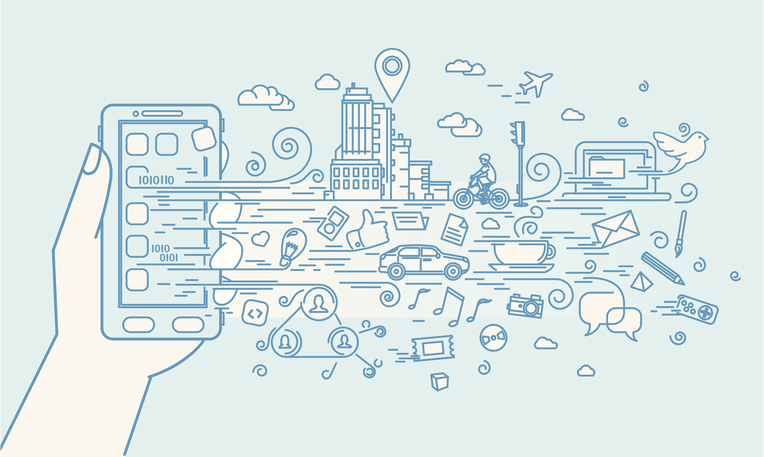
Image-Digital Fluency (Kramer, 2019).
Digital Natives:
Digital natives are generally defined as individuals born in a generation where technology is both easily accessible and widely used. It is taken for granted that this generation of individuals is inherently digitally fluent, and therefore digital pedagogies become increasingly useful (Wang, Myers & Sundaram, 2013).
Digital Immigrants:
Digital immigrants are those individuals who were born before the widespread use of technology, and as such, have had to learn to adapt to a new digital environment.
Due to this adaptation, many teachers struggle to understand how best to teach this new generation, as they speak a different ‘digital language’ (Prensky, 2001).
Digital Fluency in the Classroom:
Creating a Digitally Fluent Classroom:
Howell (2012) states that students normally have a baseline level of digital fluency when they enter school, and therefore the focus should be on a continuous development of these skills. This continuous development will not only allow them to cope with the digital workload required of them throughout their schooling and post-schooling lives, but also allow them to continue to engage in and enjoy their learning.
Image-Digital Classroom (Davidson, 2018).
Strategies:
Strategies for a Digitally Fluent Classroom:
Make use of technological resources: using available technology to enhance student engagement and increase digital fluency simultaneously. This can include the use of iPads, smart whiteboards and the many forms of multimedia information (Eady & Lockyer, 2013)
Kong (2014) advocates the use of a flipped classroom to encourage the development of digital skills. Put simplistically, a flipped classroom means that homework that is normally done outside of class time is done during class with the assistance of the teacher, and the delivery of information, which would normally take place in class, is done in students’ own time.
Benefits of Digital Fluency:
Benefits of Digital Fluency:
There are many benefits stemming from digital fluency, covering a wide variety of areas. Van Deursen (2010) covered five different areas in particular that will benefit from digital fluency. These include social, health, economic, civil and cultural benefits.
Social Benefits:
The digital landscape provides a plethora of new socialisation opportunities for all people. It provides a way to communicate over long distances and for people for whom travel is impossible or extremely difficult (Ala-Mutka, 2011).
Health Benefits:
Digital technology increases the amount of social support unwell individuals receive, especially with the creation of online support groups for those with uncommon conditions. The amount of available health information also increases, allowing individuals access to up-to-date information regarding the assessment and treatment of any health conditons (Ala-Mutka, 2011).
Image-Digital Health (The Medical Futurist, 2017).
Economic Benefits:
Digital fluency increases the employability of individuals due to the increasingly technological nature of all industries. Digital fluency paves the way for innovation and improvement in the way people work and live (van Deursen, 2010).
Image-Economic Technology (Study.com, 2019).
Civic Benefits:
People are able to be better informed about current events in the world, and are more up-to-date on information regarding their civic position. Digital technology can also be a platform for taking action, such as creating change via petitions or assisting relief efforts (van Deursen, 2010).
Cultural Benefits:
Digital technologies have allowed for the development of new kinds of self-expression and opened up a forum for discussion of one’s culture and lifestyle. Sharing information and knowledge is easier than ever, and developing connections does not have to occur in person (Ala-Mutka, 2011).
Conclusion:
Digital fluency is necessary for this generation of digital natives, as the workforce is increasingly automated and the necessity for these skills stretches even beyond that.
Not only is technology a way to keep students engaged in their learning, but utilising it in the classroom builds these skills that will be necessary for modern day life.
References:
Ala-Mutka, K. (2011). Mapping Digital Competence: Towards a Conceptual Understanding. JRC Technical Notes.
Davidson, P. (2018). Digital Classroom [Image]. Retrieved from http://edtechreview.in/news/3147-10-must-have-tools-for-your-digital-classroom
Eady, M., & Lockyer, L. (2013). Tools for learning: technology and teaching strategies. Wollongong: Queensland University of Technology.
Howell, J. (2012). Teaching with ICT. Melbourne: Oxford University Press.
Kong, S. (2014). Developing information literacy and critical thinking skills through domain knowledge learning in digital classrooms: An experience of practicing flipped classroom strategy. Computers & Education, 78, 160-173. doi: 10.1016/j.compedu.2014.05.009
Kramer, M. (2019). Digital Fluency [Image]. Retrieved from https://sites.middlebury.edu/dla/2018/03/22/what-is-digital-fluency-why-does-it-matter-some-initial-explorations/
Prensky, M. (2001). Digital Natives, Digital Immigrants Part 1. On The Horizon, 9(5), 1-6. doi: 10.1108/10748120110424816
Study.com. (2019). Economic Technology [Image]. Retrieved from https://study.com/academy/lesson/how-science-technology-economic-activity-shape-societies.html
The Medical Futurist. (2017). Digital Health [Image]. Retrieved from https://medicalfuturist.com/ten-ways-technology-changing-healthcare
van Deursen, A. (2010). Internet Skills. Vital assets in an information society. University Of Twente. Retrieved from http://doc.utwente.nl/75133/
Wang, Q., Myers, M., & Sundaram, D. (2013). Digital Natives and Digital Immigrants. Business & Information Systems Engineering, 5(6), 409-419. doi: 10.1007/s12599-013-0296-y
 Teaching and Learning in The Digital World